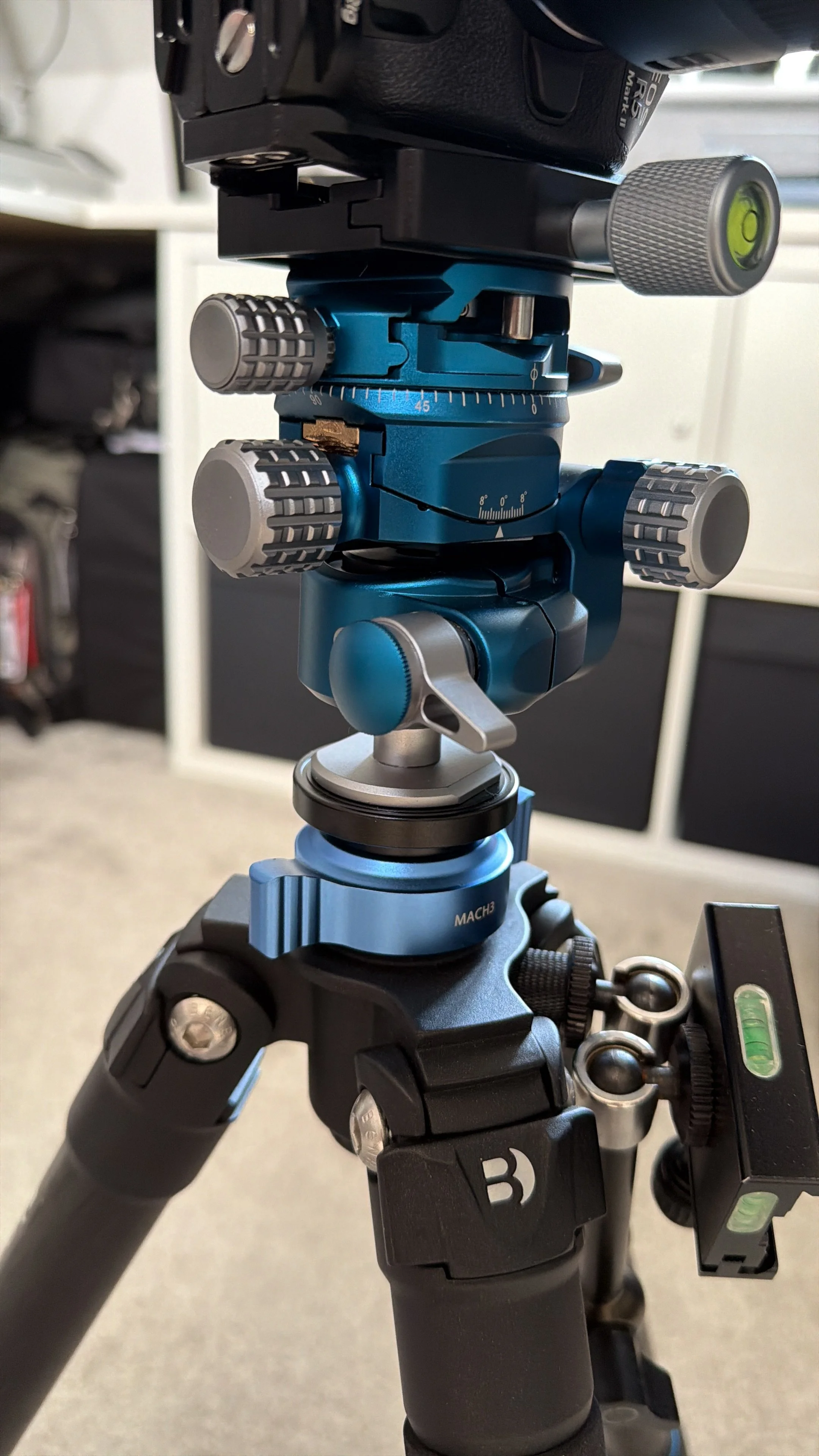
BENRO GD36P TRIPOD HEAD
My tripod has always been equipped with a ball head in some form or another. My current tripod, a carbon fibre Benro Mach 3, has up until recently has provided the legs for my Benro B3 head, which has and continues to be brilliant. A few years ago I added a tripod levelling base, the LBA1, underneath my ball head. The idea of this was to provide a horizontal platform, regardless of tripod leg position and angle, for my B3 ball head to facilitate level rotational movements for panoramic exposures. And this system, for me at least, works really well. It’s not the most slimline setup but it makes normal exposures and panoramics equally convenient. I was thinking that it would take something vastly superior to take me away from this setup
Aside from this, I’ve been curious about moving towards a geared head for sometime, which perhaps being more suitable for landscape photography, would allow for better fine tuning of landscape compositions. In fact, I have tried a couple of these over the years but have been disappointed by the robustness and build quality - there always seems to have been a degree of flimsiness which has not impressed me. I’ll stick with my B3 ball head, thanks very much…
…until I got my hands on a pre-release demo of the Benro GD36P at the Photography Show in 2024. More on that shortly.
But first, what qualities should a tripod head have for a landscape photographer? I’m aware that opinions vary, but these are mine, in no particular order:
Robust build quality
Not too heavy
Geared positioning
Arca Swiss compatible
Level panoramic rotational base
Sufficient weight load
Reasonable price
The Benro GD36P satisfies all the points in my wish list whilst simultaneously retaining a degree of ball head functionality.
KEY FEATURES
36mm low-profile inverted ball
Unlike a traditional ball head, the ball sits lower inside the housing. This lowers the camera's centre of gravity, making it feel more stable—especially with heavier cameras and lenses.
Fine geared adjustment
Once you've roughly positioned the camera, geared controls allow very small, precise movements without the camera suddenly flopping over. This is the biggest advantage over a normal ball head.
Independent pan lock
The panning base rotates 360°, allowing smooth panoramic images while keeping the camera level.
Arca-Swiss compatible
It accepts standard Arca-style quick-release plates, so it's compatible with plates from companies such as Benro, Leofoto, SmallRig, Kirk, Really Right Stuff and many others.
SPECIFICATIONS
Maximum load: 20 kg
Weight: 290 g
Ball diameter: 36 mm
Height: 77 mm
360° panning base
Bubble level
Separate pan lock
Adjustable friction control
3/8" tripod mount
CLEAR ADVANTAGES
For a landscape photographer the benefits are significant:
Very compact and light.
Much easier to make tiny horizon adjustments.
Great for stitched panoramas.
Quicker to use than a traditional three-way geared head because the geared adjustment range is relatively small—you still use the ball for larger changes.
DISADVANTAGES
No tripod head is perfect, it almost certainly wont be as rock-solid as premium geared heads from the likes of Arca-Swiss or Leofoto, but it’s in a much lower price bracket, retailing in the UK for £260.
The one big disappointment for me is the ridiculously tiny size of the Arca Swiss mount. I use a semi-open-sided L-bracket on my R5 Mark II for ease of shooting vertical format landscapes. This means that the gap in the vertical part of the l-bracket mount prevents me from using the arca swiss mount securely. It was almost a deal breaker - I very nearly sent the GD36P back for a refund. However, I solved the problem by buying a much larger separate Arca Swiss mount and attaching this to the included plate, not ideal, a bit bulkier, but I get to keep the GD36P and continue to use my l-bracket.
One last thing. The GD36P showed some play in the geared tilt part of the head - almost as if the gears were too small for the teeth. Fortunately, I noticed in the middle of the arca Swiss clamp there are two very small hex-wrench bolts. It’s not at all mentioned in the manual, but these can be tightened to adjust and allow for that play. A fraction of a turn solved this and now my GD36P is rock solid, just as I would have expected.
WOULD I RECOMMEND IT?
Yes, absolutely. Despite the teething issues with the tiny size of the arca Swiss clamp and the play in the gearing, this tripod head solves all the problems and provides three crucial elements for the landscape photographer - convenience and speed of a ball head, fine-tuned accuracy of a geared head and a level, horizontal base to shoot for stitching panoramic images together. And if, like me, you're using something like a Canon EOS R5 Mark II with lenses such as a 24-105mm or 70-200mm, the head's 20 kg rated capacity is more than adequate.
In summary, this is a really neat solution and a unique approach to a tripod head design, combining the best elements of both ball and geared heads.